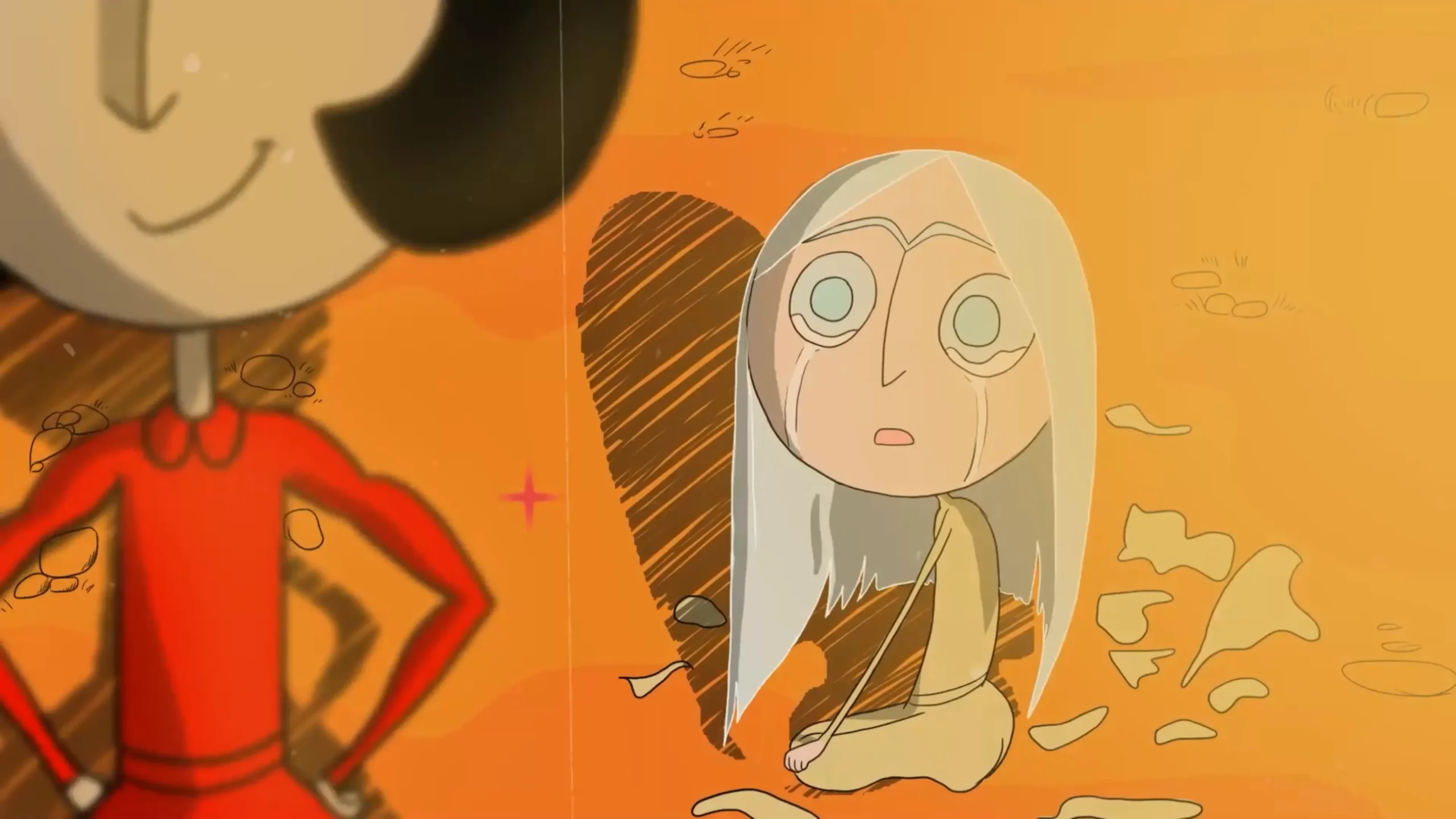

In this review of “In the Last Years of Life,” we examine a work by Minasadat Ayatollahi — a tender yet moving account of the old wounds of “difference” and the long-lasting balm of “friendship.” The filmmaker takes us on a journey through a tunnel of time, back to a scorching summer noon in the Qajar era, to trace the roots of a deep loneliness.
The Concept of Otherness in “In the Last Years of Life”
The dramatic core of the film is built around the concept of “otherness.” The little albino girl, with her blue eyes and white hair, is seen not as a child but as a “stranger” within the traditional, homogeneous society of that era. The animator delicately portrays this exclusion; the ring of bullying children surrounding her stands as a symbol of a society that cannot tolerate “difference.” Amid this, the arrival of a bold little girl who breaks through that ring is not merely the start of a friendship — it is a courageous act against oppressive norms.

The Symbolism of the Red Scarf in “In the Last Years of Life”
In terms of narrative and symbolism, the film rests on a single “color motif”: the “red scarf.” In a world where the colors fade into worn grays and browns, this red scarf serves as the “connecting thread.” This small object first becomes the reason a childhood friendship begins, then gets lost in the storm of historical events and the inevitability of the times, and finally, in the winter season of old age, becomes the key to “recognition.”
The film’s historical setting adds a layer of social determinism to the story. The separation of the two friends is not simply an incidental event; it is a reflection of a turbulent history that ruthlessly reshapes people’s fates. But the strength of the screenplay lies in the fact that it does not surrender to this inevitability. The final sequence — where the two women, now elderly and behind the haze of old age, find each other again through that same red scarf as a headscarf slips aside — is a brilliant moment of “emotion” triumphing over “time.”
Visual Style in “In the Last Years of Life”
In terms of visual style, the use of simple designs and lines reminiscent of old illustrations and lithograph prints is in complete harmony with the film’s historical atmosphere. With this animation, Minasadat Ayatollahi tells a story that, while rooted in the past, cries out an eternal truth: that “identity” and “love,” even if buried beneath years of snow, will ultimately find a way to bloom again.
Conclusion: Review of “In the Last Years of Life”
To learn more about the Qajar era in which this work is set, you can also read this article. If you’re also interested in our review of “Cycle” or our review of “Bug,” you can find them on our site as well.